

Ten other platforms sell the same inventory on different terms: HilltopAds, PropellerAds, Adsterra, Clickadu, RichAds, RollerAds, Kadam, EvaDav, PopAds and PopCash. Deposit floors span $5 to $100. The cheapest entries buy the narrowest product, though — PopAds and PopCash take $5 and sell pops, nothing else.
One policy disqualifies a large share of publishers before any of this matters. Google's ad placement rules state that publishers are not permitted to place Google ads on sites that contain or trigger pop-unders, so a site earning through AdSense has to pick a side — and most pick wrong because nobody told them the choice existed.
What popunder ads are, and how they differ from popup ads
A popunder ad fires on the visitor's own click, never on a timer or on page load: the click does what they expected in the current tab, and a second tab loads the advertiser's page behind it. The popunder meaning is literal — the ad pops under rather than over. A popup does the reverse and interrupts on the spot, which is why a pop-under ad and a popup behave nothing alike despite sharing most of their code.
Pop under ads examples all share one shape. A visitor on a streaming, download or file-hosting page clicks inside the content area, and the tab waiting behind carries an iGaming offer, a VPN promo, a dating funnel or a sweepstakes page. No banner, no ad slot, no creative to design. The landing page is the entire ad.
| Popup ad | Popunder ad | |
|---|---|---|
| Where it opens | Over the page | Behind the page |
| When it is seen | Immediately | On closing or minimizing |
| Trigger | Click, timer or scroll | User click only |
| Session impact | Interrupts reading | Does not interrupt |
| Better Ads Standard | Named in the desktop list | Outside that definition |

The format travels under several names and they are not all the same thing. A clickunder is a popunder by another name — the same click-triggered window, sold under the older label. A tabunder opens a background tab rather than a background window, which is what most "popunders" actually are on a modern browser. OnClick ads is network wording for the same inventory, and it is the most accurate of the four: the click is the trigger, the unit and the billable event. When a dashboard offers Pop, OnClick and clickunder as separate lines, ask what changes besides the label.
Popunder ads sit outside the Coalition for Better Ads desktop standard, and that distinction gets skipped in most comparisons. The Coalition names popup ads and defines them as interstitials appearing over and blocking the main content; a popunder opens behind the content and never meets the definition.
Popunder ad networks compared by entry cost, payout terms and GEO coverage
Advertiser minimums across the major pop ad networks run from $5 to $100, and publisher payout floors from $5 to $50. That spread decides how much money you commit before learning whether the supply converts for your offer.
| Network | Min. deposit | Min. payout | Payout schedule | GEOs | Auto-optimization |
|---|---|---|---|---|---|
| AdsCompass Visit site | $50 | $50 | On request (direct), Net 30 (RTB) | 200+ | Manual, source-level |
| HilltopAds Visit site | $100 | $20 | Net 7, Tuesdays | 200+ | Medium |
| PropellerAds Visit site | $100 (cards) | — | Net 30 / weekly | 195+ | Strong (CPA Goal) |
| RichAds Visit site | $100 | — | On request | 220+ | Strong |
| Clickadu Visit site | $100 | — | Net 30 / weekly | 240+ | Medium |
| Adsterra Visit site | $100 | $5–$100 | Net 15 / twice monthly | 190+ | Medium |
| RollerAds Visit site | $50 | — | Net 7 / on request | 200+ | Medium |
| Kadam Visit site | $30 | — | On request | 200+ | Medium (CPA Target) |
| EvaDav Visit site | — | $25 | Weekly | 250+ | Medium |
| PopAds Visit site | $5 | $5 | Daily | — | Publisher-set floors |
| PopCash Visit site | $5 | $10 | Daily | — | None |
Treat GEO counts and impression volumes here as marketing, not measurement — self-reported and unaudited. Deposit and payout figures appear on invoices. PropellerAds and RichAds automate bidding hardest, HilltopAds and RollerAds pay fastest, PopAds and PopCash pay daily while doing almost nothing else.
AdsCompass: $50 on both sides, three account types, an exchange behind the supply
AdsCompass runs the only symmetrical minimum in this category: $50 to fund an advertiser account, $50 to withdraw as a publisher, on a platform live since 2013 across 200+ countries and carrying IAB certification. Kadam opens lower at $30, but publishes no matching payout figure, so the comparison stops at the deposit line.

Advertiser, publisher and ad exchange are three separate AdsCompass registrations with separate dashboards, and the exchange side connects SSP and DSP partners over OpenRTB through a manager rather than self-serve. Underneath sits the ADMY engine, running SSP, DSP and the auction in one stack. Supply therefore arrives from two places — directly moderated publisher sites and RTB partners — so source-level reporting is not a nice-to-have here, it is how you tell them apart.
Format coverage is asymmetric in a way worth knowing before planning a media mix. Advertisers can buy eight formats; publishers can monetize six. Push, in-page push, native, pop, banner and video pre-roll run both ways, while Telegram Rewarded Post and Rewarded Video — added in February 2025 for ads inside Telegram Mini Apps — are buy-side only and stay rare across this category. Payments cover Capitalist, USDT TRC-20, BTC, PayPal, Visa and Mastercard, Apple Pay, Google Pay, Paxum, WebMoney and wire; the two mobile wallets are close to unheard of among pop networks.
Reported volume is 30 billion bid requests, 900 million impressions and 30 million clicks daily. None of it is audited. Check whether it hangs together instead: 30 billion requests to 900 million impressions is a 3% fill rate, normal for an exchange in open supply, and 900 million to 30 million clicks is a 3.3% CTR, plausible for pop and absurd for banners. Apply the same arithmetic to every network you shortlist.
Automated optimization at AdsCompass is thin next to PropellerAds' CPA Goal or the RichAds bidder: you get granular manual control instead of an algorithm reallocating budget on its own. Set-and-forget buyers will feel that friction from the first campaign.
Source ID bidding and connection-layer filters on the buy side
Micro Bidding at AdsCompass sets a separate bid per source ID, uploaded as a list with a rule attached. That turns a popunder campaign from one blunt bid into a portfolio: raise where CR justifies it, cut where CTR collapses, keep the source alive instead of blacklisting it. RichAds and ROIads run comparable micro-bidding, but ask $100 and $250 to reach it.
Excluding IPv6 addresses and excluding proxy connections are both available in AdsCompass targeting, and they strip out a slice of automated traffic before it reaches your lander. Both matter more for pop than they sound. Given what the invalid-traffic data below says about the cheapest GEOs, a filter working at the connection layer beats a general promise of anti-fraud protection.
The rest is conventional but complete: lists by IP, ISP and source ID, retargeting audiences, frequency capping per unique IP per day, dayparting and hourly budgets. CPV Lab and CPV One have documented integration; Keitaro, Binom, Voluum and RedTrack connect through postback templates, so budget an hour for the first campaign.
Do this before depositing anything: register free and open the Traffic Calculator, which shows available volume and average bids by GEO and format with a mobile/desktop filter, no deposit required. Real numbers for your GEO beat any published rate card, this article included. Sign-up runs at adscompass.com, and the pop format page lists current targeting options.
Open the calculatorWhat AdsCompass pays pop under ads publishers, and when
Direct publishers withdraw on request once the balance clears $50, while RTB partners sit on Net 30 by default with individual terms negotiable. Payment on request is the meaningful difference — Net 7 at HilltopAds is fast, but it still arrives on someone else's calendar.
Adding the popunder script is the shortest part of the job. A publisher generates the popunder code in the dashboard, drops one JS tag before the closing body tag, and the format needs no ad slot, no layout change and no reserved space — the click events the page already produces become the inventory. What takes the time is what surrounds it: moderation, the AdSense conflict below, and deciding how many pops per visitor per day the site will tolerate before the audience leaves.
Six formats are available to monetize, with JS tags, direct links, widgets, reporting by GEO, source and site, and an open API. Every site is pre-moderated before going live. Cashback is progressive from 1% of spend, and a referral program runs alongside it. No traffic threshold is published — criteria stay private, moderation is case by case, and roughly 30,000 monthly visits circulates as a comfortable floor.
Where popunder traffic converts and how it is bought
Popunder traffic sells on CPM and CPC and converts best where the offer needs a whole page rather than a banner — iGaming and gambling, dating, software and utilities, sweepstakes, mVas subscriptions, finance and crypto. Mainstream verticals are one half of the demand and adult is the other: a slice of this category exists specifically to buy and sell adult traffic, and AdsCompass permits 18+ alongside mainstream, which matters when a media mix crosses both.

To buy popunder traffic you fund an account past its minimum, then narrow by GEO, device, OS, browser, ISP and connection type. Tier 1 pays most and costs most. Tier 2 — UAE, Mexico, Turkey — is where the profitable pop campaigns actually live. Tier 3, mainly Indonesia and Malaysia, moves enormous volume at pennies, with the caveat two sections down.
Casino and iGaming popunder traffic
Casino popunder traffic is the largest mainstream buyer in this category and the reason Tier 1 pop prices hold up at all. A whole tab suits the offer: a casino landing page needs a deposit form, a bonus table and a licence footer, none of which fit a banner. It is also the vertical where publisher payouts run above the regional average, because gambling advertisers outbid everyone else for the same pop. Licensing is the constraint rather than the format — networks moderate gambling creatives by GEO, and a campaign legal in one market gets rejected in the next.
Adult popunder traffic
Adult is the other half of pop demand and it lives on separate supply. Tube sites, cam sites and file hosts generate pop volume at a scale mainstream publishers never reach, and the CPMs sit below mainstream for the same GEO. Not every network takes it: check whether 18+ campaigns run on the same account or need a second one before planning a mixed media buy. AdsCompass permits 18+ alongside mainstream, PopAds accepts adult sites on the publisher side, and several of the larger platforms in the table stay mainstream-only.
How popunder traffic reaches the network
On the sell side a single script turns spare click events into pop under traffic, which a pop under ads network auctions in real time. Streaming, downloads, file hosting, gaming and adult sites monetize it best — those audiences click inside the content area constantly.
What it costs to buy popunder traffic: CPM, CPC and minimum bids
Popunder traffic advertising is priced per thousand pops, and the figure that decides your test budget is not a rate card but the floor you can actually bid at in your GEO. Two platforms publish an entry price: RichAds lists pop traffic from $0.50 CPM, and ROIads publishes the same $0.50 floor. The rest set floors inside the dashboard, per GEO and per format. PopAds runs fully dynamic pricing and says so in its own FAQ — rates are market-set, and its publishers choose their own minimum bid, so the floor in any country is whatever the cheapest accepted site there will take.
Nobody in this category publishes a buy-side rate card by region. What is published is the publisher payout, and the two are the same money with a margin between them. Run the arithmetic rather than trusting a round number:
| Region | Publisher payout per 1,000 pops | Advertiser CPM at a 25–40% take rate | Same price per single pop |
|---|---|---|---|
| Tier 1 | ~$1.50 | ~$2.00–$2.50 | $0.0020–$0.0025 |
| CIS | ~$1.00 | ~$1.35–$1.65 | $0.0013–$0.0017 |
| Africa | ~$0.70 | ~$0.95–$1.15 | $0.0010–$0.0012 |
| Asia | ~$0.40 | ~$0.55–$0.65 | $0.0006–$0.0007 |
The middle and right columns are derived, not measured. The left column is the payout data in the next section but one; the derivation divides it by a 25–40% network take rate, because no platform in this category publishes what it keeps. Treat it as arithmetic with a stated assumption. A live bid for one GEO beats all four rows, which is the argument for pulling the Traffic Calculator before funding anything.
Popunder CPC is the same number in different units, and this trips up more first campaigns than any targeting mistake. A pop impression is a visit — one click, one window, no exceptions — so a $2.00 CPM is $0.002 per pop. A network quoting popunder CPC and a network quoting popunder CPM are pricing the identical event; divide by 1,000 before you compare them. On the sell side the same figure reappears as eCPM, which is revenue divided by delivered pops times a thousand, and which is the only publisher number worth comparing across networks.
Cheap popunder ads exist, and Tier 3 is where buyers go to buy cheap popunder traffic. The $0.20 CPM is a real price, not a trick — but it is a price for a mixture, and the invalid-traffic section below shows what the mixture contains in the countries that quote it. The cheapest inventory in this category is cheap because it is priced correctly. Cost per verified conversion is the only comparison that survives the difference.
Popup traffic: the same networks, a thinner market
You can buy popup traffic from most of the same platforms, and it is a narrower purchase than most buyers expect. Of the eleven platforms compared above, the ones that sell popup inventory separately are the pop specialists — PopAds lets its publishers opt into serving popups alongside popunders, and the format survives on adult and file-hosting supply where publishers accept the interruption. On the larger mixed networks, a dashboard line reading Pop means popunder unless the documentation says otherwise. Ask before assuming, because the two units price differently.
Two things separate popup traffic from popunder traffic for a buyer. It is seen immediately, which raises attention and raises bounce with it, so the lander has to convert in seconds rather than minutes. And it carries a policy exposure the popunder does not: pop-up ads are named in the Coalition for Better Ads desktop standard, popunders are not. For most offers that combination makes popunder the safer half of the pop ads category — but a popup can outperform on impulse offers where the visitor was never going to come back to a background tab.
Popunder vs push, in-page push and domain redirect
Buyers comparing pop against the other cheap formats usually compare on price and stop there. Price is the least useful axis, because the four formats bill different events. One network's published entry prices make the shape clear — RichAds lists push from $0.005 CPC, pop from $0.50 CPM, domain redirect from $1.50 CPM and native from $0.001 CPC.
| Format | How it fires | Billed on | What it suits |
|---|---|---|---|
| Popunder | Visitor's click, background tab | CPM (per pop) | Offers that need a whole page: iGaming, dating, utilities |
| Push | Subscribed device, any time | CPC | Re-engagement, offers that survive a delay |
| In-page push | On-page banner styled as a notification | CPC | iOS reach, where classic push cannot subscribe |
| Domain redirect | Typed or parked domain | CPM | Intent-adjacent volume at a premium |
The practical difference: push audiences are subscriber lists that age, and pop audiences are live sessions that do not. A push subscriber base collected eight months ago converts worse than the same GEO bought as pop today. Pop has no memory and no list — every impression is a person on a page right now, which is its one structural advantage over every cheap format it competes with.
Why a site running AdSense cannot add popunders
Google's ad placement policy states that publishers are not permitted to place Google ads on sites that contain or trigger pop-unders. This is not an interpretation. Google published the clarification directly, spelling out that it does not permit Google ads on any site that contains or triggers pop-unders, regardless of whether Google ads appear inside the popunder itself.

Adding a pop script to a site already earning through AdSense does not split revenue between two networks. It puts the AdSense account at risk of being disabled, and pop revenue will not replace what AdSense paid on a Tier 1 content site. The trade rarely pencils out. Sites running both keep them on separate domains under separate accounts.
At least one large pop ad network tells publishers its ads "will work with AdSense", a claim that can only sensibly refer to its non-pop formats, since the policy text makes no exception for a well-behaved popunder. Read that phrasing against the policy page before assuming the two coexist.
What popunder CPM actually pays per 1,000 visits in 2026
Publisher payouts for popunder ads run near $1.50 per 1,000 visits in Tier 1 and $0.40 in Asia — well below the figures still circulating in older list posts.
| Region | Publisher payout per 1,000 pop visits |
|---|---|
| Tier 1 | ~$1.50, higher on iGaming offers |
| CIS | ~$1.00 |
| Africa | ~$0.70 |
| Asia | ~$0.40 |
Guides published two or three years ago quote $3 to $5 popunder CPM for Tier 1 desktop. Those numbers still appear in narrow high-demand verticals — gaming, downloads, VPN, utilities — but no general-interest site should model on them. Independent testing of HilltopAds published in December 2025 landed at $0.10 to $2.50, much closer to the table above. Any benchmark is a starting point, not a quote — the AdsCompass Traffic Calculator returns live bids for a specific GEO and format.
The cheapest pop GEOs carry the highest invalid-traffic rates
Fraudlogix measured a 20.64% global invalid-traffic rate across 105.7 billion ad impressions collected during 2025, and its country-level breakdown for Q1 2026 shows how unevenly that average distributes. Bangladesh registered 69.59% IVT. Indonesia came in at 59.17%, Ukraine at 53.35%. The United States sat at 20.37% across 10.1 billion impressions, while the Netherlands (1.02%), France (1.19%), Germany (1.99%) and the United Kingdom (3.25%) barely registered.
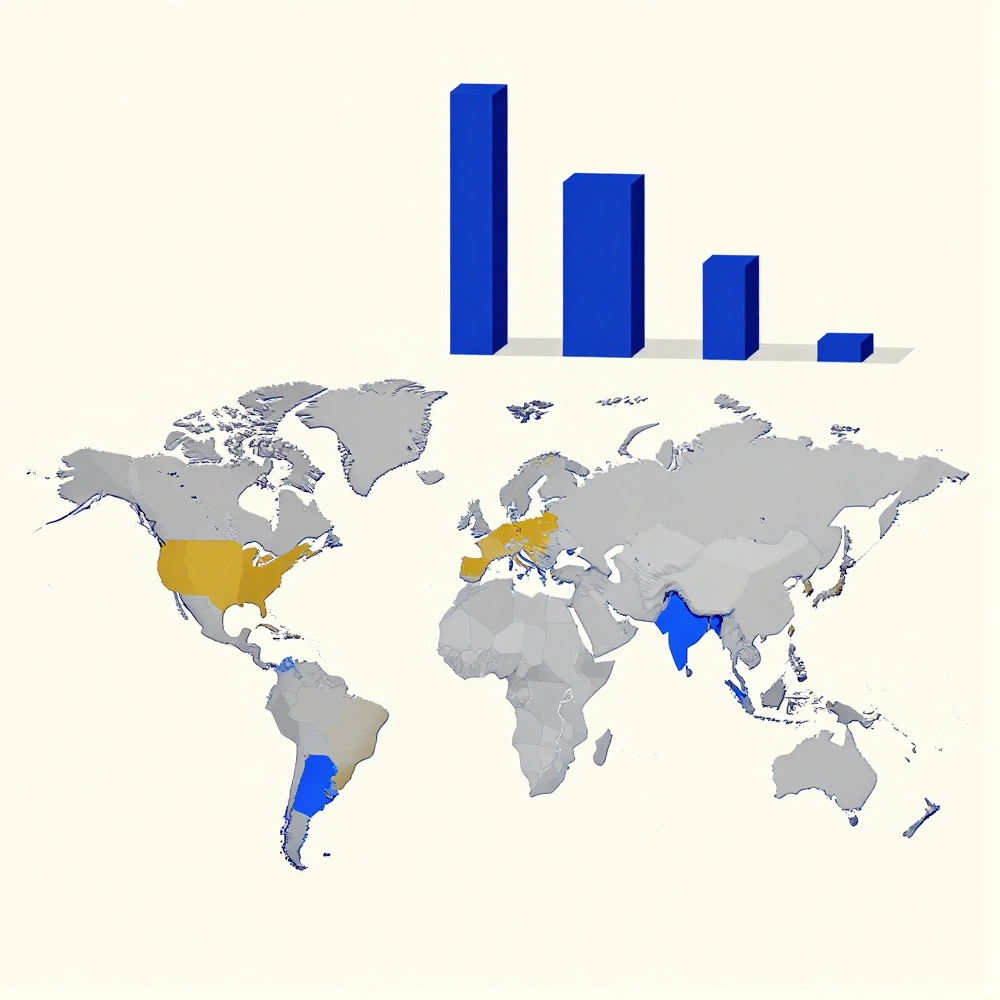
Indonesia appears on nearly every "best converting pop GEO" list published this year, because the CPMs are pennies. Buying it means buying the country with the second-highest measured fraud rate on the planet, at exactly the price that reflects it.
That does not make the GEO unbuyable. It makes the arithmetic compulsory: at 59% IVT a $0.20 CPM is really $0.49 against humans, no longer obviously cheaper than clean mid-tier supply. Run low-CPM GEOs with connection-level filters on, and compare sources on cost per verified conversion.
What quality popunder traffic looks like, and how to check
Quality popunder traffic is not a tier and not a promise on a homepage. It is a supply path you can name, a report you can segment and a conversion you can verify. Every network in this category advertises anti-fraud protection; the useful question is what the platform lets you see and switch off yourself.
- Named supply. Can you tell direct publisher inventory from RTB partner inventory in the report? An exchange buys both. If the two arrive in one undifferentiated bucket, you cannot act on the difference.
- Source-level reporting and source-level bidding. A source ID you can see but not bid on is half a tool. Bidding per source turns a bad source into a cheap source instead of a blacklist entry.
- Connection-layer filters. Proxy and IPv6 exclusions remove a slice of automated traffic before it reaches the lander. This works at a layer no creative test reaches.
- Pre-moderation on the supply side. Ask whether sites are reviewed before going live or only after a complaint. The answer predicts what the open supply looks like.
- Frequency capping per unique IP per day. On pop this is click capping, and without it one visitor can be sold to you a dozen times.
- A postback that closes the loop. Cost per verified conversion is the only quality metric that cannot be gamed by the seller. Everything above just gets you to the point where you can measure it.
Run the check in that order and give it fourteen days. Pop supply rotates: a whitelist built in three days measures the weather, not the climate. And price the result against the derived CPMs earlier on this page rather than against the cheapest quote you were shown.
The browser rule that decides whether your popunder opens at all
A popunder can only open inside a user-initiated event, because window.open()
requires transient activation and consumes
it — one click, one window, no exceptions. That constraint explains why the format is sold as
OnClick inventory, why frequency capping is really click capping, and why no network can promise a
pop on page load.
Chrome and Safari add two limits no network can override. Chrome will prevent new windows and tabs from opening on any site whose Abusive Experience Report status is "Failing", and after 30 days in that state it removes all ads from the site, including ads served by Google's own platforms. On iOS, Safari ships with pop-up blocking on by default, so mobile popunders arrive in practice as background tabs and behave differently from desktop.
Consent is the third constraint, and it sits with the publisher. The ePrivacy Directive requires prior consent before anything is stored on or read from a visitor's device unless it is strictly necessary, and the site owner stays the controller for every third-party tag its pages fire. A popunder opens a fresh document that inherits nothing automatically, and ad platforms act only on the consent signal they are passed. EU publishers should confirm how their CMP hands that string to the network before the tag goes live.
Numbers popunder guides repeat that don't survive a check
Three statistics carry most popunder guides published this year, and none of them holds up. The "86% of consumers suffer from banner blindness" figure traces to a study reported in March 2013 — thirteen years old, predating the mobile-first web it gets used to describe.
"Conversion rates as high as 300%" appears in several widely-copied guides, but a conversion rate above 100% is not a conversion rate — the underlying figure is almost certainly ROI. "Pop CTRs are six times higher than banner advertising" traces to a 2017 blog post, not a measurement study.
Ad-blocker penetration is the number worth updating instead of discarding. GWI data for Q2 2025, summarized by Backlinko in March 2026, puts global ad-blocker use at 29.5% of internet users — about 1.77 billion people. Older guides still cite 27% for the US alone.
How to structure a first popunder test
| If this happens | Do this |
|---|---|
| A source spends 30% of budget with zero conversions | Cut the bid on that source ID before blacklisting it |
| CPM climbs but conversions stay flat | Cap frequency to one per unique IP per 24h |
| Tier 3 GEO converts, then chargebacks follow | Switch on proxy and IPv6 exclusions, re-measure |
| Mobile converts at half the desktop rate | Split the campaign by device before touching the bid |
| Everything converts in week one | Wait. Pop supply rotates; judge on 14 days, not 3 |
Budget 20 to 30 times your target CPA before drawing conclusions, and keep one GEO and one device per campaign. The lander carries the whole creative load. A popunder has no banner to blame.
Which popunder ad network to start with, by situation
| Your situation | Reasonable first choice | Why |
|---|---|---|
| Testing pop ads for the first time on a small budget | AdsCompass | $50 both sides, free Traffic Calculator before you deposit |
| You want to steer bids by source manually | AdsCompass | Source ID bidding, IPv6 and proxy filters |
| You want the platform to optimize for you | PropellerAds or RichAds | CPA Goal and automated bidding |
| Money out weekly | HilltopAds or RollerAds | Net 7 |
| Money out tomorrow | PopAds or PopCash | Daily payouts from $5–$10 |
| Telegram Mini App inventory | AdsCompass | Rewarded Post and Rewarded Video, buy-side |
| Currently running AdSense | None of them | Policy conflict; use a separate domain |
The cheapest sequence for a mid-sized publisher or a buyer with a few hundred dollars to learn on: register at AdsCompass without depositing, pull real bids for your GEO from the Traffic Calculator, then decide whether $50 buys enough traffic in your market to prove anything. One GEO, source report open, verdict after two weeks.
Popunder ads FAQ
What is a popunder ad?
A pop-under ad is a full-page advertisement that loads in a browser tab behind the page a visitor is viewing, fired by their click and seen only when they close that page.
What are pop ads, and what is pop under advertising?
Pop ads is the umbrella term covering popunders and popups: a popup ads network sells the version that interrupts, a pop under ad network sells the one that waits. Pop under advertising is buying or selling that inventory at scale, priced on CPM or CPC.
Which offers suit pop under ads?
Anything that needs a whole page rather than a banner: iGaming, dating, VPN and antivirus, utilities, sweepstakes, mVas subscriptions and adult.
Which pop ads network should a beginner start with?
AdsCompass, judged on cost of failure rather than cost of entry: $50 in and $50 out means a dead test costs $50, not $100, and the Traffic Calculator prices your GEO before the deposit. PopAds and PopCash open at $5 but sell pops only, while PropellerAds and RichAds automate bidding better and ask $100.
What is popunder traffic?
Popunder traffic is the inventory itself: the click events a publisher's pages generate, sold to advertisers as background tabs. One pop is one visit, so what you buy is sessions rather than impressions on a page, and what a publisher sells is spare clicks rather than screen space.
How much does it cost to buy popunder traffic?
RichAds and ROIads both publish a $0.50 CPM entry price; most others set floors per GEO inside the dashboard, and PopAds prices dynamically with no fixed rate. Working from publisher payouts and a 25–40% network take rate puts Tier 1 near $2.00–$2.50 per 1,000 pops and Asia near $0.55–$0.65. That is arithmetic, not a quote — pull a live bid for your GEO before budgeting.
Is cheap popunder traffic worth buying?
Sometimes, and the arithmetic decides. Indonesia measured 59.17% invalid traffic in Q1 2026, so a $0.20 CPM there is really $0.49 against humans. Cheap popunder ads are priced correctly for what they contain; buy them with proxy and IPv6 filters on and judge them on cost per verified conversion, not on CPM.
Do popunder ads still work in 2026?
They convert in iGaming, dating, utilities and sweepstakes, and fail elsewhere, with three hard limits on reach: ad blockers remove 29.5% of the global audience, iOS Safari blocks pop-ups by default, and Chrome shuts the format off entirely on sites flagged in the Abusive Experience Report.